 By Meghna Sharma
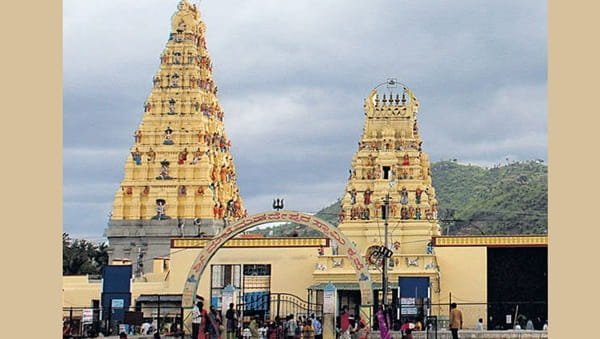
In the forested hill country of Karnataka’s Chamarajanagar district, Sri Male Mahadeshwara Swamy Temple is a pilgrimage centre shaped as much by local song and living folklore as by formal Shaiva worship. Known widely as MM Hills or Male Mahadeshwara Betta, the shrine honours Lord Shiva in a sacred linga form associated with the saint Mahadeshwara, whose life and miracles have been sung across southern Karnataka for generations.
The setting is memorable. Seven hill groups rise around the temple, and roads wind through an ecologically sensitive landscape near the Karnataka–Tamil Nadu border. Pilgrims come from Mysuru, Bengaluru, Kollegal and Tamil Nadu for darshan, festival processions and offerings made in fulfilment of family vows. The temple has a strong place in the folk identity of the region, with Kamsale music and stories of Mahadeshwara riding a tiger among its best-known traditions. Because the shrine is in a hill and forest area, reaching it involves more planning than a routine city temple visit, particularly during the monsoon and the largest annual jathras.
Male Mahadeshwara Temple Timings, Entry Fees and Pujas
Karnataka’s official temple-management listing publishes a morning visitor window of 6:00 AM–10:30 AM and an afternoon window beginning at 12:00 noon, continuing until 6:45 PM. It also notes that darshan is arranged outside abhishekam periods and that devotees already in the night queue may be accommodated. These details are not the same as an unconditional promise of continuous entry until 10:00 PM.
| Activity | Officially listed / practical schedule |
| Morning darshan window | 6:00 AM–10:30 AM |
| Midday ritual break | About 10:30 AM–12:00 noon |
| Afternoon darshan window | 12:00 noon–6:45 PM |
| Early abhisheka | Around 4:00 AM–6:00 AM |
| Later/night queue | Subject to temple staff and ritual arrangements |
| General darshan | Usually free |
| Selected sevas | Separate charges |
Abhisheka and Special Sevas
The temple’s Karnataka HR&CE listing identifies services such as Rudrabhisheka, Rudra Trishati, Basava Vahana, and other processional or special pujas. The published fee schedule includes ₹400 for a particular Ekavara Rudrabhisheka category and ₹200 for Rudra Trishati; prices and availability should always be reconfirmed before payment. Festival-day restrictions may alter the usual sequence.
Wear modest clothing and follow temple instructions for offerings, phones and photography. The official temple authority is the best source for current queue arrangements, accommodation and seva tokens. Beware of unverified social-media accounts claiming exclusive paid VIP entry.
Male Mahadeshwara Temple History and Religious Significance
The Saint Who Became the Heart of the Hills
The temple’s sacred history centres on Male Mahadeshwara, revered as a Shaiva saint and divine manifestation whose presence is associated with the late medieval period, often described broadly as the fourteenth or fifteenth century. Karnataka Tourism links his spiritual life to the hill region and reports a tradition that he settled here and attained samadhi. In local devotion, however, Mahadeshwara’s story is far larger than an ordinary biography; he is regarded as a protector of people living in villages and forests.
Oral narratives describe him travelling from the Srisailam region through parts of Karnataka before making the hills his spiritual home. These episodes are important to community memory, but the precise dates and routes cannot all be verified through contemporary written records.
The Seven Hills and Their Sacred Names
The surrounding landscape is traditionally described as Elu Male, the seven hills, with names such as Anemale, Jenumale, Kadumale, Kanumale, Ponnachimale, Pavalamale and Pachchemale in local listings. Their names and sequence vary across folk retellings, a reminder that oral traditions evolve across communities. The temple at the heart of this landscape draws significance from the hills themselves, not only from the structure housing the linga.
The dense forest setting once made pilgrimage difficult, contributing to stories of tests, journeys, rescue and divine intervention. Today’s improved roads allow more people to visit, but the region remains environmentally sensitive and cannot be treated as an unrestricted recreation ground.
Huli Vahana and the Folk Epic
One of the most vivid images of Mahadeshwara is Huli Vahana, the saint riding a tiger. Stories sung in Kannada describe his efforts to protect villagers and spiritual seekers, overcome hostile forces and guide communities toward ethical conduct. The Male Mahadeshwara folk epic is an important part of Karnataka’s oral literature, preserved through performance rather than a single canonical text.
Kamsale, the striking rhythm performed with cymbal-like instruments, is closely associated with Mahadeshwara devotion. The tradition conveys a history of faith across social groups and generations. Rather than reducing these performances to entertainment, visitors should recognise their role in local religious life.
Temple Development and Institutional History
Accounts of the temple’s expansion refer to local supporters and connections with the Salur Mutt, historically important in the religious administration of the shrine. The present temple complex includes a sanctum for the linga, ceremonial spaces, subsidiary shrines and facilities for large pilgrim gatherings.
The management system has changed over time, and the site now appears in Karnataka’s official Hindu Religious and Charitable Endowments temple directory. This provides an identifiable administrative source for seva fees and operating hours. The temple’s older spiritual associations and its current buildings should not be presented as though they were created in one securely documented year.
How To Reach Male Mahadeshwara Temple
| Transport | Connection | Approximate distance |
| Road | Hanur to MM Hills | Roughly 35–45 km |
| Road | Kollegal to MM Hills | Roughly 70–80 km |
| Road | Mysuru to MM Hills | Around 130–150 km |
| Road | Bengaluru to MM Hills | Route-dependent, often 200+ km |
| Rail | Mysuru Junction | Approximately 140 km by road |
| Air | Mysuru Airport | Road journey via district routes |
By Air and Train
Mysuru is a practical transport hub, with trains, airport connections and road transport onward toward Hanur. Travellers from Bengaluru may find direct road services or connections via Kollegal convenient. Do not assume that the temple has a railway station in the hills.
By Road
Buses operate from regional towns, with additional services sometimes arranged for large festivals. Private cars follow hill roads passing through forested sections. Use the designated route, follow speed restrictions and avoid unnecessary night driving in wildlife-sensitive areas. Road work, weather and festival controls may affect the journey.
Best Time To Visit Male Mahadeshwara Temple
| Season | Months | Travel considerations |
| Winter | November–February | Pleasant hill weather and popular pilgrimage period |
| Summer | March–May | Warm daytime conditions; carry water |
| Monsoon | June–September | Lush scenery but rain and slippery roads |
| Festival periods | Shivaratri, Ugadi, Deepavali and other jathras | Large crowds and traffic control |
Maha Shivaratri is among the most important observances, with special puja and heavy attendance. Ugadi and Deepavali also bring major jathras, while other regional festivals feature processions and offerings. Confirm dates and access arrangements with the temple authority for each calendar year.
Nearby Attractions
The MM Hills landscape and viewpoints provide views of surrounding forests where public access is allowed. The Male Mahadeshwara Wildlife Sanctuary is an important protected habitat, not an open-access trekking area: activities need authorisation and must respect conservation rules. Hanur and the route through Kollegal offer opportunities to understand the area’s local culture. Longer itineraries may include Shivanasamudra Falls, but it is not a quick walk or short detour from the temple.
Accommodation and Essential Travel Tips
Temple-area pilgrim lodging may be offered subject to availability, and hotels can be found in larger towns such as Kollegal or Mysuru. Reserve early for festival days. Carry required identification, drinking water, regular medicines and modest warm clothing for cool mornings. Do not feed wildlife or stop in restricted forest stretches for photography. Pilgrims with mobility challenges should ask about queue support and vehicle access directly at the temple rather than assuming a paid ticket guarantees priority.
Frequently Asked Questions About Male Mahadeshwara Temple
Q1. Who was Male Mahadeshwara according to local tradition?
He is revered as a Shaiva saint and divine protector associated with the hill region roughly six centuries ago. Folk narratives celebrate his miracles, compassion and guidance to local communities; these stories form devotional heritage rather than a fully documented biography.
Q2. Why is Mahadeshwara shown riding a tiger?
The tiger is known as Huli Vahana in folk tradition. It symbolises the saint’s command over the forest and its dangers. This is an iconographic and narrative association, not a practice involving animals at the temple.
Q3. What is Kamsale, and is it part of the pilgrimage culture?
Kamsale is a vigorous traditional performance using paired instruments and rhythmic movement, often devoted to Mahadeshwara. It is an important carrier of Kannada folk history and religious storytelling.
Q4. Can visitors trek freely through the surrounding sanctuary?
No. The surrounding forest is protected habitat. Enter only routes open to the public and follow forest-department restrictions. Temple entry does not grant permission for independent trekking or wildlife activities.
Q5. Are night queues guaranteed to continue until every late visitor arrives?
No. The official listing describes accommodation for devotees already in the queue under certain conditions. That is different from guaranteed unrestricted entry at any late hour; follow instructions on the day.
Q6. Is Male Mahadeshwara the same temple as Nanjangud or Srikanteshwara?
No. Male Mahadeshwara Temple is at MM Hills in Chamarajanagar district. Nanjundeshwara/Srikanteshwara Temple is a separate Shiva shrine at Nanjangud, near Mysuru. Both may appear in Karnataka pilgrimage itineraries but must not be combined as one listing.