 By Meghna Sharma
Few temples shape a town’s daily life as completely as Sri Krishna Temple at Guruvayur in Kerala. Before daybreak, devotees gather for Nirmalyam, the early ceremony in which the Lord is worshipped at the start of the devotional day. Later come elaborate offerings, lamps and the rhythmic Seeveli processions that have made Guruvayur one of India’s most enduring centres of Krishna devotion. The presiding deity, Guruvayurappan, is regarded as a form of Maha Vishnu worshipped with the affection associated with Krishna.
Situated in Thrissur district, Guruvayur is often called Bhooloka Vaikuntham, the earthly abode of Vishnu. Its Kerala-style shrine, rich musical heritage, traditions of Krishnanattam, and thousands of family weddings connect sacred practice with everyday culture. The temple is administered by the Guruvayur Devaswom, which publishes online arrangements for darshan, offerings and accommodation. Unlike many public temples, entry to its inner premises is restricted to Hindus, and the dress code is specific. Those details are just as important as the aarti schedule when preparing a respectful and trouble-free visit.
Guruvayur Temple Timings, Entry Fees and Pujas
Official Kerala Tourism information lists the shrine’s general periods as 3:00 AM–12:30 PM and 4:30 PM–9:15 PM. Some detailed ritual lists describe a later end to midday proceedings, so do not confuse temple ritual time with uninterrupted public darshan. The schedule varies on festival days, Udayasthamana Pooja days and periods of exceptional crowding.
| Activity | General schedule |
| Temple opening and Nirmalyam | Around 3:00 AM |
| Morning worship / public darshan | 3:00 AM–12:30 PM, with ritual interruptions |
| Midday closure | Around 12:30 PM–4:30 PM |
| Evening session | 4:30 PM–9:15 PM |
| Deeparadhana | Commonly around early evening; confirm daily |
| General darshan | Free, subject to queue or applicable online arrangements |
| Special seva and accommodation | Separately booked and charged |
Main Daily Rituals
Important ceremonies include Nirmalyam, Usha Pooja, the processional Seeveli, Ucha Pooja, Deeparadhana, Athazha Pooja and the concluding Thrippuka. The temple follows an intricate worship cycle in which gates may close temporarily between offerings. Photography and mobile-phone use within restricted areas are not allowed; use approved storage facilities and obey security directions.
Dress Code, Entry and Official Booking
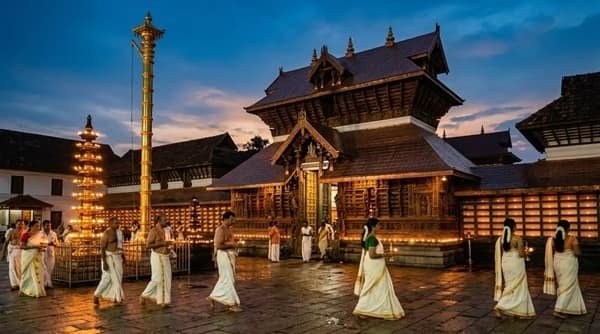
The Devaswom states that men should wear a dhoti and angavastram or approved upper cloth, while women may wear a saree, chudidhar or half-saree according to its published dress rules. Avoid assuming that ordinary jeans and shirts will be accepted. The temple’s own online portal states that it does not authorise outside agents for darshan, offerings or accommodation. Use Devaswom channels for any advance booking and never share OTPs with strangers.
Guruvayur Temple History and Religious Significance
The Legend of Guru and Vayu
Guruvayur’s most cherished origin account explains its name through Guru (Brihaspati), the preceptor of the gods, and Vayu, the wind deity. According to tradition, they brought a sacred image of Lord Vishnu to the region and installed it at the place that became Guru-Vayu-ur. The deity is therefore revered as Guruvayurappan. Some accounts connect the image with Krishna’s ancient city of Dwarka, describing it as rescued before that legendary city’s submergence.
These narratives illuminate how the temple understands its sacred inheritance; claims that the present masonry is five thousand years old should not be treated as historical proof. The visible shrine and its institutional traditions developed across several documented centuries.
Medieval Devotion and the Bhakti Poets
By the late medieval period, Guruvayur had become a major Vaishnava centre. Its devotional legacy is inseparable from poets and saints such as Melpathur Narayana Bhattathiri, who composed the celebrated Narayaneeyam, and Poonthanam Nambudiri, remembered for accessible Malayalam Krishna devotion. Their literary traditions gave Guruvayur a place in both elite Sanskrit learning and the everyday religious culture of Kerala.
The Zamorin of Calicut and other regional patrons contributed to the temple’s ritual and cultural life. The historical record is not a single uninterrupted building story: there were episodes of rebuilding, political turmoil and repairs over the centuries.
Destruction, Repair and the 1970 Fire
Popular temple histories recall damage and recovery during the upheavals of the eighteenth century. Another clearly dated turning point occurred on 30 November 1970, when a serious fire swept through parts of the complex. Local accounts remember people from different religious communities helping to contain it. The central sanctum and certain important structures were preserved, and restoration work followed.
The episode illustrates how a pilgrimage institution can survive physical change while maintaining worship traditions. The modern Devaswom system manages the temple’s considerable flow of pilgrims, weddings, festivals, offerings and accommodation without erasing its centuries-old ritual identity.
Kerala Architecture, Music and Krishnanattam
The shrine follows Kerala’s distinctive temple architecture, including tiled roofs, lamp structures, courtyards and the central Sreekovil. Processional routes and deepastambhams create a ceremonial atmosphere unlike the tall stone gopurams of much of Tamil Nadu.
Guruvayur is also associated with Krishnanattam, a classical dance-drama telling stories from Krishna’s life, and with Chembai Sangeetholsavam, the well-known music festival that honours the Carnatic musician Chembai Vaidyanatha Bhagavatar. The temple’s worship and artistic life are therefore closely connected.
How To Reach Guruvayur Temple
| Transport | Connection | Approximate distance |
| Rail | Guruvayur Railway Station | 1–2 km |
| Rail | Thrissur Railway Station | 27–30 km |
| Air | Cochin International Airport | Around 80–90 km |
| Road | Thrissur | About 28–30 km |
| Road | Kochi | Roughly 90–105 km |
| Road | Kozhikode | Roughly 95–110 km |
By Air and Train
Cochin International Airport is the practical airport for many visitors. Guruvayur Railway Station is close to the temple, but Thrissur has wider train connections for long-distance travel. Buses and taxis connect the two towns.
By Road
KSRTC and private buses operate services through Thrissur and other Kerala centres. Traffic near the temple can be congested during auspicious wedding dates, Ekadasi and holiday weekends. Private cars may need to use designated parking away from the entrance.
Best Time To Visit Guruvayur Temple
| Season | Months | Practical conditions |
| Winter | November–February | Most comfortable, but busy during religious periods |
| Summer | March–May | Hot and humid afternoons |
| Southwest monsoon | June–September | Heavy rain, though worship continues |
| Post-monsoon | October | Variable rain; festival activity begins to increase |
Guruvayur Ekadasi is among the most important annual observances, drawing large crowds and special lamp ceremonies. Ashtami Rohini, the Krishna birthday celebration, is also highly significant. The Chembai music festival and annual temple festivals add to the cultural calendar. Dates change with the Malayalam religious calendar.
Nearby Attractions
Mammiyur Mahadeva Temple, a revered Shiva shrine, is traditionally included by many pilgrims in their Guruvayur circuit. Punnathur Kotta elephant camp is associated with the Devaswom’s elephants; visitor access and animal-welfare rules may change. Chavakkad Beach offers a coastal excursion, while Thrissur’s Vadakkunnathan Temple is a major heritage site for travellers staying longer.
Accommodation and Essential Travel Tips
The Guruvayur Devaswom operates accommodation and provides official booking services, while private hotels are plentiful around the temple. Book early on festival and wedding dates. The early Nirmalyam queue can be demanding for older visitors; plan rest and food breaks outside the shrine. Confirm any special access arrangement with the Devaswom rather than paying an unknown broker. Non-Hindu companions must respect the temple’s current entry rules and can enjoy other places in the town.
Frequently Asked Questions About Guruvayur Temple
1. Can visitors of all religions enter Guruvayur’s inner temple?
No. The temple’s established entry policy restricts access to Hindus. Travellers of other faiths should respect the rule and may explore publicly accessible parts of Guruvayur town and nearby attractions.
2. Is an online free-darshan booking always compulsory?
The Devaswom periodically opens advance free-darshan booking windows, but availability and queuing arrangements change. Check the official portal for your travel month rather than assuming that either walk-in or online entry is universally mandatory.
3. What is the significance of Nirmalyam?
Nirmalyam is the early devotional viewing associated with the beginning of the temple’s daily worship. It carries special significance because devotees assemble before dawn to witness the first stage of the ritual cycle.
4. Is Mammiyur Mahadeva Temple part of the same complex?
No. Mammiyur is a separate Shiva temple in Guruvayur. Many pilgrims visit it because of a local devotional tradition, but it has its own management, opening hours and entry rules.
5. Can couples marry at Guruvayur Temple without advance planning?
The shrine is famous for wedding ceremonies, but registration, permitted slots, documents and facilities depend on Devaswom requirements. Families should verify the current procedure in advance and not rely on an outside agent’s verbal promise.
6. Why is Krishnanattam especially associated with Guruvayur?
Krishnanattam is a classical dance-drama devoted to episodes from Krishna’s life. It developed within Kerala’s religious-cultural world and remains an important part of Guruvayur’s artistic identity, distinct from ordinary daily darshan.