 By Meghna Sharma
On Nilachal Hill above Guwahati, Kamakhya Temple occupies a special place in India’s tradition of Goddess worship. The shrine is revered not for a conventional carved image of the deity but for a naturally formed sacred cleft in the rock, associated with a perennial spring. Pilgrims descend into an intimate inner chamber, while the distinctive domed temple and the surrounding Mahavidya shrines give the hill an atmosphere found nowhere else in the region.
Kamakhya is counted among the major Shakti Peethas and is central to Assam’s living Shakta and Tantric traditions. Its June Ambubachi festival, which marks the annual symbolic menstruation of the Goddess, attracts devotees from across India. Equally important is the temple’s layered history: earlier forms of worship predate the standing buildings, while Koch and Ahom rulers shaped much of the present complex.
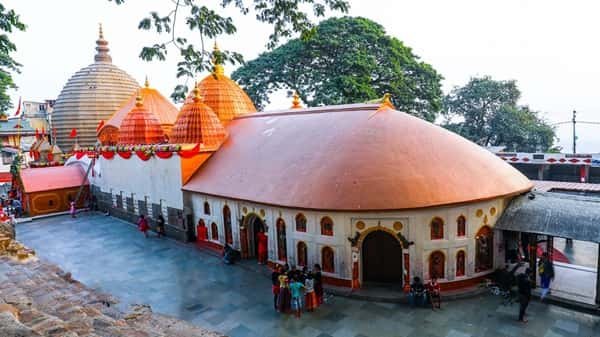
Practical planning matters here. The shrine’s public doors do not remain open until the evening aarti, and the temple administration has issued specific warnings about unofficial online pujas and ticket sellers. This guide covers both the sacred background and the arrangements visitors genuinely need.
Kamakhya Temple Timings, Entry Fees and Pujas
The main public darshan windows and ritual breaks are listed below. These are planning hours, not a promise of uninterrupted viewing; special festivals, weather and temple notices can alter the normal schedule.
Kamakhya Temple Darshan Timings
| Activity / session | Temple administration schedule |
| Daily cleaning and bathing | 5:30 AM |
| Daily puja | 6:00 AM |
| Public morning darshan | 8:00 AM – 1:00 PM |
| Midday bhog and closure | 1:00 PM – 2:30 PM |
| Public afternoon darshan | 2:30 PM – 5:15 PM |
| Evening aarti (not public darshan) | 7:30 PM |
These periods come from the official temple programme. The shrine’s public doors close before the evening aarti; do not mistake the aarti time for an additional evening darshan window.
Important Daily Pujas and Sevas
The official shrine offers free general-queue access and a separate special-darshan system. A 2026 notice placed special tickets through its designated official online portal and reported a ₹501 ticket during the Ambubachi period; current slot fees should be checked at the authorised portal. The temple warns against unrelated websites selling online pujas.
Free general-queue darshan is provided. In June 2026 the Devalaya announced that special-darshan morning and afternoon coupons would be available through its designated official portal rather than normal counter booking. The authority also warns that it has not authorised unrelated sites to sell online pujas; check maakamakhya.org for valid channels and notices.
Dress Code and Visitor Rules
No tobacco is allowed anywhere in the Nilachal complex. Use only the authorised official ticket channel and be respectful of photography and ritual restrictions.
Wear modest, comfortable clothing, remove footwear at the designated place and carry as little as possible into the queue. Nilachal Hill has been declared a no-tobacco zone. Inner-sanctum photography is inappropriate and may be prohibited; ask staff before filming anywhere in the complex.
Kamakhya Temple History and Religious Significance
The Shakti Peetha legend and the sacred underground sanctum
Kamakhya’s most important legend belongs to the story of Sati. After she died at the sacrificial gathering of her father Daksha, Shiva carried her body in grief. According to Shakta tradition, Vishnu’s discus divided the body into sacred relics that fell at different sites. Kamakhya is especially associated with the yoni, the creative feminine principle. These accounts explain the hill’s religious standing; they are not archaeological descriptions of how or when the shrine was built.
The garbhagriha expresses that belief directly. Instead of an anthropomorphic idol, worship centres on a stone opening reached by steps into a dim lower chamber, with water flowing naturally at the sacred site. This form of worship links divine power with fertility and creation. Tantric texts, regional ritual traditions and the culture of Assam have made Nilachal Hill an influential religious centre over many centuries. It would be misleading, however, to reduce the temple to sensational claims about occult rituals; for most devotees it is a place of prayer, offerings and family pilgrimage.
Koch reconstruction, Ahom patronage and the Nilachal complex
The architectural history is distinct from the legend. Scholars generally trace worship on Nilachal Hill to an early medieval period, while the surviving temple combines work from later rulers. The former structure was damaged in the sixteenth century. Kamrup Metropolitan district records its reconstruction under Koch ruler Chilarai in 1565, in the reign of Naranarayan. Later Ahom patronage contributed additional building and ritual support. This helps explain why the present shrine displays several architectural phases rather than one uninterrupted ancient building.
Its characteristic rounded, beehive-like superstructure rises above a sequence of chambers that culminate in the low inner sanctuary. Around it stand temples associated with the Mahavidyas—forms of the Divine Mother including Kali, Tara, Bhuvaneshwari and Bagalamukhi—alongside Shiva shrines. Priestly and managerial traditions remain active, with hereditary service groups connected to worship. Each June, Ambubachi interrupts routine darshan for several days before the temple ceremonially reopens. That festival expresses the shrine’s emphasis on the generative power of the Goddess.
How To Reach Kamakhya Temple
Kamakhya stands on Nilachal Hill in western Guwahati, reached by a winding road from the city. Buses and local vehicles serve the hill approach, but congestion can be substantial at weekends and festivals. The final sanctum visit involves steps and a tight interior space.
| Mode | Practical access point |
| By air | Lokpriya Gopinath Bordoloi International Airport, around 20–25 km |
| By train | Guwahati Railway Station, about 8–10 km |
| By road | Taxis and city transport climb Nilachal Hill from Guwahati |
By Air
Lokpriya Gopinath Bordoloi International Airport, around 20–25 km. Flights, connections and transfer times vary. Confirm that the selected airport has a convenient onward taxi or bus link rather than judging suitability by map distance alone.
By Train
Guwahati Railway Station, about 8–10 km. Check whether the train stops at the stated station and arrange local transport for the final leg, especially if arriving after dark or with elderly relatives.
By Road
Taxis and city transport climb Nilachal Hill from Guwahati. Roads near religious sites are sometimes pedestrianised or subject to temporary diversions on festival days. A drop-off point within walking distance can be more practical than trying to drive to the main gate.
Best Time To Visit Kamakhya Temple
The most comfortable general travel season is October to March. Temperatures, rainfall and daylight conditions affect queueing outdoors, walking between attractions and using public transport. Devotees specifically seeking a festival experience may prefer a busier season, provided they allow time for crowds and altered schedules.
| Season | Visitor conditions |
| October–February | Generally comfortable for pilgrimage |
| March–May | Warm to hot and humid |
| June–September | Monsoon rain; plan extra travel time |
Major Festivals
Important annual occasions include Ambubachi Mela in June, Durga Puja and Manasa Puja. Such celebrations change the atmosphere considerably: decorated deities, processions or extended worship may be a highlight, but queues and room prices can rise. Families wanting a relatively quiet darshan should prefer an ordinary weekday outside the main festival period.
Nearby Attractions
A visit to Kamakhya Temple can be combined with several nearby places. Pick attractions according to the time available rather than trying to cover every stop after a long darshan queue.
- Bhubaneswari Temple on Nilachal Hill
- Umananda Temple on Peacock Island
- Assam State Museum in Guwahati
Before adding a distant attraction, check opening times and the driving route. A religious journey is usually more comfortable when one significant site is explored properly instead of several being rushed.
Accommodation and Essential Travel Tips
Queues can be lengthy even on ordinary days. At Ambubachi, public entry closes for several days and special-pass services may be suspended. Verify the daily official notice before starting uphill.
Book a room in a convenient town rather than choosing accommodation only by the lowest displayed price. Ask about check-in rules, parking, accessibility and the last local bus. Carry identification, drinking water, essential medicines and a modest amount of cash for small purchases. Where official booking facilities exist, use the genuine temple or church channels rather than agents who promise guaranteed priority access.
Frequently Asked Questions About Kamakhya Temple
Q. Can devotees book an online puja from any website using the Kamakhya name?
No. The Devalaya has publicly warned against unauthorised websites and apps advertising online pujas in its name. Use only links published by the temple administration, and do not assume that a payment to a travel agent or social-media account is an authorised religious service.
Q. Is the evening aarti also an evening public darshan session?
Not necessarily. The official daily programme lists ordinary public access ending earlier than the 7:30 PM aarti. The aarti is a ritual time, not proof that new visitors will be admitted to the sanctum then. Arrive during the public entry periods.
Q. Why is there no conventional idol in the main sanctum?
The object of worship is a naturally formed sacred stone cleft associated with water and the creative power of the Goddess. This distinguishes Kamakhya from many temples where an upright carved image occupies the central shrine. Photography or touching the holy site should not be assumed permissible.
Q. What happens during Ambubachi Mela?
Routine worship and public access are interrupted for a symbolic period marking the Goddess’s annual menstruation. The temple then reopens following purification and customary rites. Because crowds can be exceptional, visitors should read the official notice for the particular year’s closure, reopening and ticket restrictions.
Q. Can elderly visitors avoid the steepest approach to Nilachal Hill?
Vehicles can reach the hill area by road, but the final entrance and the lower sanctum still involve waiting, steps and narrow spaces. Families should ask the temple staff about current assistance before joining a long queue; a road journey to the hill is not the same as step-free sanctum access.
Q. Are the Mahavidya temples included in one main-sanctum queue?
No. The Mahavidya shrines are spread across the Nilachal complex and have their own positions and rituals. Exploring several of them requires extra walking and time. Visitors interested in the whole sacred landscape should plan for more than a quick central darshan.