 By Editor
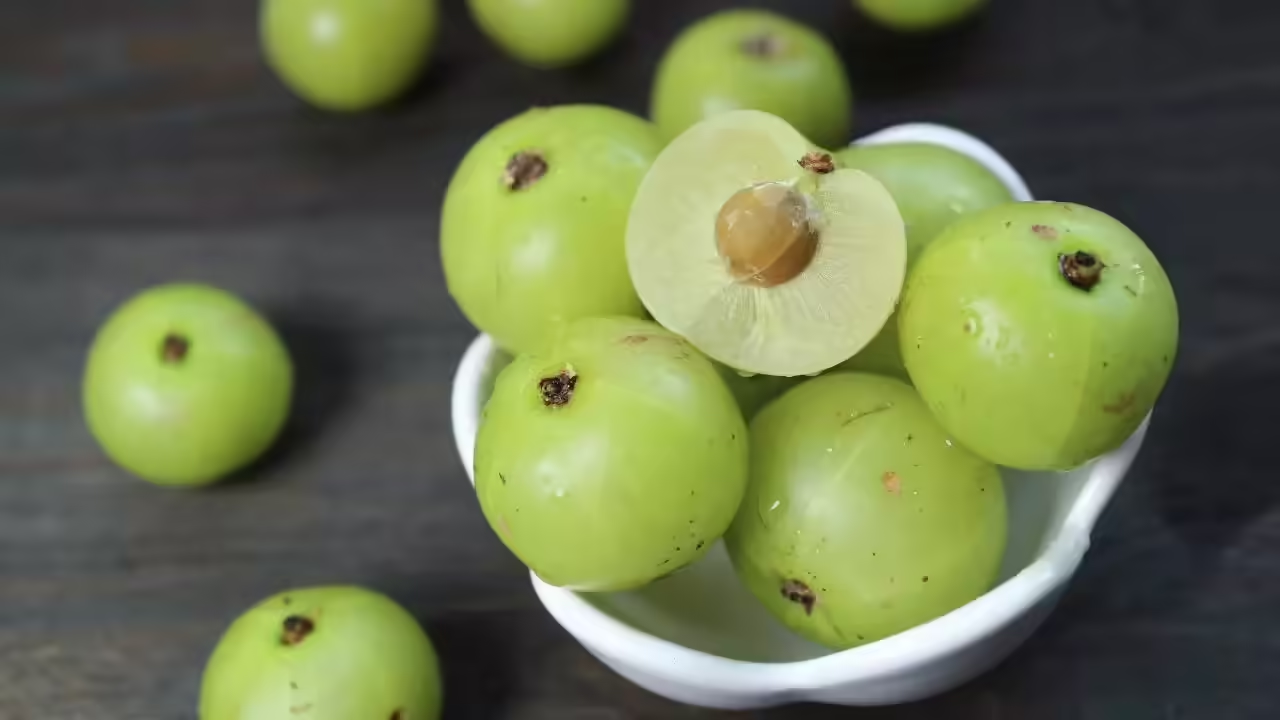
 No doubt, Amla, aka Indian gooseberry, is specific to India only, and when it comes to the overall production of it, no doubt, India ranks as the largest producer out there. But right here in India as well, it is produced in different states, some growing in large quantities and ranking as the highest amla-producing states in the country. So, for some reason, you always wanted to know where most of the amla in India comes from, then just keep on reading this list of the Top 5 Amla Producing States in India. Let’s get going then.
1. Madhya Pradesh
In the amla production scene, by looking at the production numbers, it becomes pretty much clear how Madhya Pradesh has super easily surpassed many states in India so much that it is even hard to catch up to or keep up with. See, based on the data for 2023-24, the state of MP was responsible for the production of approximately 487 thousand tonnes of amla, and that year, this was just a little of 35% of the total amla production of the country. But how’s this possible for MP? See, Madhya Pradesh is the state which tops this list mainly due to the perfect combination of its dry and semi-humid regions that are the natural habitat of amla trees.
2. Uttar Pradesh
Oh, and the second place is taken by Uttar Pradesh and to be fair, it is almost as mind-boggling as Madhya Pradesh in terms of production. Pretty similar, actually! Talking in specific terms, well, in 2023-24, UP had a production of close to 426 thousand tonnes, which was nearly 31% of the whole of India. Besides that, the provisional results for 2024-25 are already showing the production going beyond 437 thousand tonnes. And just in case you’re wondering why the production of amla is so high in UP, see, there isn’t any particular reason, but it makes more sense, seeing how UP is pretty much the top-ranking state in a lot of other crop production in the country.
3. Tamil Nadu
No doubt, we get it like it may be a little surprising that Tamil Nadu is ranked third, but the state has been consistently making its mark in the amla sector. Its production was close to 208 thousand tonnes in 2023-24, and that’s just a little over 15% of the total production in the country, and the new estimates for 2024-25 are even higher than 218 thousand tonnes. How and what works for Tamil Nadu, though? Oh, well, the weather situation somehow works, like the dry areas in the middle of the land and the more humid parts have made it possible to farm the amla in the region.
4. Gujarat
How much does Gujarat produce? Oh, that’s about 70 thousand tonnes of amla as per the 2023-24 data officially provided by the government. And just in case you’re wondering, that is about 5% of the total national amla production. Comparing to the top 3 states in this list, Gujarat seems to be falling behind, but things can turn over really fast if everything goes right in the amla production and more people take part in it, no doubt.
5. Chhattisgarh
Alright, so this is pretty much the end of this list and here you’ll find Chhattisgarh with almost 3% of the total production in India. In numbers? Oh, to put it in numbers, see, in the fiscal year 2023-24, Chhattisgarh produced about 40 thousand tonnes. So the 3% number comes from there. And if you look into the intricate details of the production itself, see, most of the amla agriculture in Chhattisgarh is through tribal and rural communities, which are scattered in forest and plateau areas. The fruit is going to the processing units in the central part of India more and more because of the continuous improvement of the road from Raipur to the neighboring states.
Conclusion
Mainly, when you see Amla production in India properly spread out across states, well, these are the top 5 states that rank high, and the production numbers are right in front of you. India itself is a large consumer of amla, so sure enough, the price of amla depends a lot on these states’ production amount every single year.